When choosing a makeup brush, people often focus on the brush shape, bristle material, or handle design.
However, there is another important factor that can significantly affect how a brush performs:
Bristle density.
Two brushes may have a similar shape but completely different application results because one has tightly packed fibers while the other has a much looser structure.
A dense brush can help create more coverage and controlled application, while a fluffy brush is often better for light distribution and soft blending.
For beauty brands, makeup artists, retailers, and product developers, understanding brush density can help create more functional and well-balanced makeup brush collections.
In this guide, we explain what makeup brush density means, how it affects application, and which types of brushes are suitable for different makeup products.
Makeup brush density refers to how closely the bristles are packed together inside the brush head.
Generally, makeup brushes can be grouped into three broad levels:
The fibers are relatively loose and separated.
These brushes usually provide:
Lightweight application
Soft blending
Diffused color
Less concentrated product pickup
The fibers are packed more closely together while still allowing flexibility.
These brushes can provide a balance between:
Product pickup
Blending
Coverage
Control
The fibers are tightly packed together.
These brushes are often designed for:
Higher coverage
Buffing
Controlled application
Liquid and cream makeup
The exact performance still depends on fiber type, fiber length, brush shape, and product formula.
A dense makeup brush contains a relatively large number of fibers packed closely together.
Because the fibers support each other, the brush head generally feels more structured and firm than a loose, fluffy brush.
Dense brushes are often used for:
Foundation
Cream contour
Cream blush
Concealer
Powder foundation
Buffing
A dense brush can provide:
Higher product pickup
More product can remain within the brush head during application.
More controlled distribution
The closely packed fibers can help move makeup across the skin with less diffusion.
Buildable coverage
Dense face brushes are commonly selected when a stronger or more polished finish is desired.
A fluffy makeup brush has a looser arrangement of fibers.
The longer and more flexible fibers can move more freely during application.
Fluffy brushes are often used for:
Setting powder
Bronzer
Blush
Highlighter
Eyeshadow blending
A fluffy brush can provide:
Soft blending
Lightweight application
Diffused color
Wider coverage
For example, a large fluffy powder brush can distribute setting powder across the face without concentrating too much product in one area.
The differences can be summarized simply:
| Feature | Dense Brush | Fluffy Brush |
|---|---|---|
| Fiber Arrangement | Closely packed | Loosely packed |
| Product Pickup | Higher | Lighter |
| Coverage | Medium to high | Light to medium |
| Blending | Controlled | Soft and diffused |
| Best For | Foundation, cream products | Powder, blending |
| Application | Buffing / pressing | Sweeping / diffusing |
| Brush Feel | Structured | Flexible |
Neither type is automatically better.
The right choice depends on the cosmetic formula and the intended result.
Foundation is one of the clearest examples of how density changes brush performance.
A high-density synthetic foundation brush can be suitable when the goal is:
Medium to full coverage
Smooth blending
Buffing
Controlled application
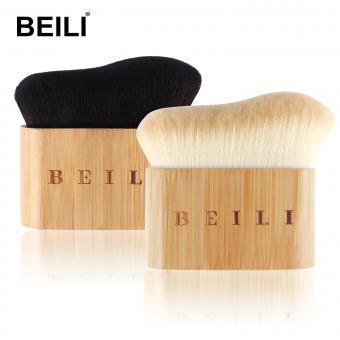
Flat-top and densely packed Kabuki-style brushes are commonly used for this type of application.
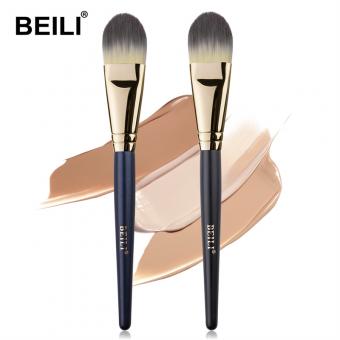
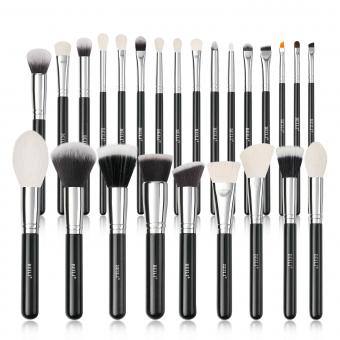
BEILI currently offers synthetic foundation brush designs as well as Kabuki-style face brushes, providing different configurations for complexion application.
A medium-density brush can provide more flexibility.
It may be suitable for:
Everyday foundation
Buildable coverage
Blending
Lightweight cream products
A loose brush head may produce a lighter application, although this depends strongly on the shape and fiber construction.
For sheer coverage, a less dense configuration can be useful.
Powder brushes usually require a different balance.
A low- or medium-density powder brush can be ideal for:
Loose powder
Pressed powder
Finishing powder
Light bronzer
The loose fibers allow the product to spread across a wider area.
A denser powder brush can provide more controlled pickup.
This can be useful when applying:
Powder foundation
Powder bronzer
More concentrated powder products
BEILI's current range includes large powder brush designs intended for powder, blush, and highlighter applications.
Blush is another product where density matters.
A fluffy brush can provide:
Soft color
Diffused edges
Gradual build-up
This can be useful for powder blush and more natural-looking application.
A denser brush gives more control and can pick up more pigment.
It may be preferred for:
Highly pigmented blush
Cream blush
Targeted application
For beauty brands, offering both softer and denser blush brush designs can create more choices within the same product category.
Contour products usually require precision rather than simply maximum product pickup.
A dense angled brush can provide:
Controlled placement
Defined lines
Stronger color payoff
A softer brush can help create:
Diffused definition
Gentle transitions
More natural-looking contour
The shape of the brush and its density should therefore be developed together.
An angled brush with high density will behave very differently from an angled brush with long, loose fibers.
Density is particularly important for eyeshadow brushes.
A compact shader brush is designed to pick up and deposit eyeshadow efficiently.
It is useful for:
Packing eyeshadow
Metallic shadows
Pigmented formulas
A medium-density blending brush can provide a balance between control and movement.
It is commonly used for:
Crease work
Transition shades
Soft blending
A fluffy brush is designed to diffuse color and soften edges.
It can be useful for:
Transition colors
Large crease areas
Final blending
Density should never be evaluated on its own.
The final performance depends on a combination of:
Fiber + Density + Length + Shape
For example, two high-density synthetic brushes can have very different feels if one uses short, stiff fibers while the other uses longer, softer fibers.
Similarly, a fluffy brush made from one fiber type may feel completely different from a fluffy brush made from another.
When developing makeup brushes, all four elements should therefore be evaluated together.
Synthetic fibers can be manufactured with controlled dimensions and characteristics, allowing brush developers to create different levels of density and flexibility.
Synthetic makeup brushes are especially common in modern beauty collections because they can be developed for a wide range of applications, including liquid, cream, and powder formulas.
BEILI's current product range includes synthetic and vegan-oriented brush collections, including foundation, powder, eye, and multifunctional brush designs.
For a beauty brand, this flexibility allows different brush designs to be developed within one consistent collection.
Brush density can influence the final appearance of makeup.
Often provides:
Light + Soft + Diffused
Suitable for a natural finish.
Often provides:
Balanced + Buildable + Versatile
Suitable for everyday makeup.
Often provides:
Controlled + Concentrated + Polished
Suitable for fuller coverage and more precise applications.
However, the final finish is not determined by density alone.
Product formula, user technique, brush shape, and fiber characteristics all contribute to the result.
Yes, a well-balanced collection can benefit from using several density levels.
For example:
Foundation Brush
High density
Concealer Brush
Medium to high density
Powder Brush
Low to medium density
Blush Brush
Medium density
Highlighter Brush
Low to medium density
Shader Brush
High density
Blending Brush
Medium density
Soft Blending Brush
Low density
This creates a collection where every brush has a specific role.
When several brands sell similar brush shapes, density can become an important product-development variable.
Instead of launching another generic:
Foundation Brush
a brand could create a more specific product:
High-Density Synthetic Foundation Brush
Or:
Soft-Density Powder & Finishing Brush
This gives customers a clearer reason to choose one product over another.
Density can also become part of a broader product specification alongside:
Bristle material
Brush shape
Brush head size
Handle material
Ferrule design
Intended formula
Application technique
Avoid vague descriptions such as:
Premium Brush
Professional Brush
Super Soft Brush
Instead, provide useful product information.
For example:
Dense synthetic fibers provide controlled product pickup and smooth buffing for liquid and cream foundation.
Soft, loosely arranged fibers distribute setting powder evenly for a lightweight finish.
Balanced fiber density provides controlled blush application with smooth, buildable blending.
This type of description is more useful to both customers and search engines because it explains what the product does and why.
| Makeup Product | Recommended Density | Typical Goal |
|---|---|---|
| Liquid Foundation | Medium–High | Coverage & blending |
| Cream Foundation | High | Controlled application |
| Concealer | Medium–High | Precision |
| Powder | Low–Medium | Soft distribution |
| Powder Blush | Medium | Controlled color |
| Cream Blush | Medium–High | Placement & blending |
| Bronzer | Low–Medium | Diffused application |
| Contour | Medium–High | Definition |
| Highlighter | Low–Medium | Targeted glow |
| Eyeshadow Packing | High | Strong product pickup |
| Eyeshadow Blending | Low–Medium | Soft diffusion |
| Eyeliner | High / Firm | Precision |
These are general design guidelines rather than fixed rules. The appropriate density also depends on fiber length, stiffness, shape, and product formula.
Makeup brush density is an important part of brush design that can influence product pickup, coverage, blending, control, and finish.
Dense brushes are often suitable for foundation, cream products, and concentrated application.
Medium-density brushes provide a balance between control and blending.
Fluffy brushes are commonly used for powder, bronzer, blush, and soft transitions.
For beauty brands developing a complete makeup brush collection, combining different density levels can create a more functional and versatile product range.
BEILI offers a range of makeup brushes for complexion, eye, and multi-functional applications, including synthetic brush designs, Kabuki brushes, powder brushes, brush sets, and other beauty tools.
Explore BEILI makeup brushes to find different brush designs, densities, and applications for your next beauty collection.
1102, Hefei Software Park Luyang Incubation Park, Luyang District, Hefei City, Anhui Province
Tel : +86 13355501971
Whatsapp : +86 13355501971
Correo electrónico : jenny@beilimakeup.com


Enlaces amigables :
Dingsheng Cosmetics Packaging Compatible con red IPv6